· 7 min read
Decentralisation Is Not About Crypto
James Godwin
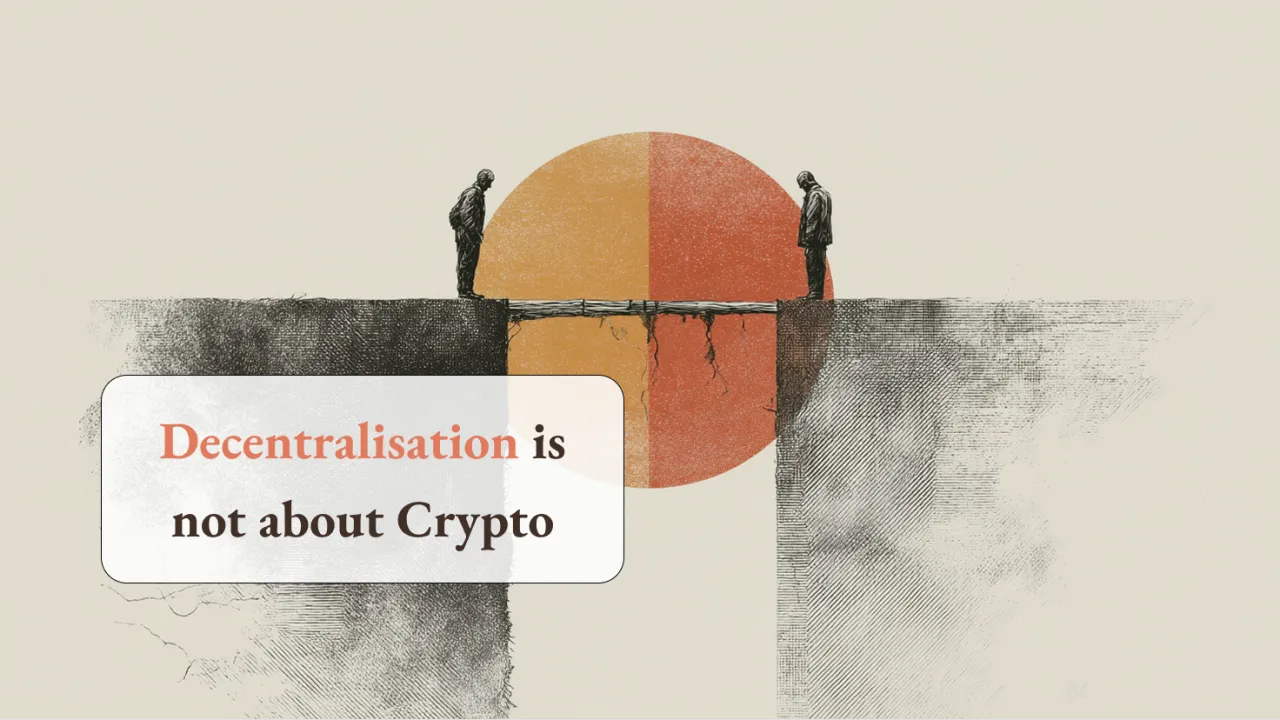
When people dismiss cryptocurrency, I often find myself wanting to slow the conversation down. Not because I think every coin matters. Not because I think speculation is interesting.
But because I think most people are stopping at the wrong layer.
Crypto may be the doorway, but decentralisation is the deeper mind shift: learning to imagine order without a centre of control.
The deeper question is not whether someone should buy Bitcoin, trade tokens, or believe in a particular blockchain. The deeper question is what happens when a civilisation built around centres of authority begins to imagine order without a familiar centre of control.
That is a much larger shift.
For most of human history, we have organised ourselves around centres. The king. The chief. The church. The government. The university. The corporation. The central bank. The CEO. The expert. Knowledge, power, legitimacy, and decision-making have tended to flow outward from a recognised centre.
Even our psychology follows the same pattern.
We look for the answer. We look for the leader. We look for the correct way. We look for someone who can tell us what is true, what is safe, what is valuable, and what we are supposed to do next.
This is not a criticism. It is understandable. Centralised systems reduce uncertainty. They give people a place to look when the world feels too complex. When pressure rises, the body often wants a centre. Someone in charge. A clear instruction. A point of certainty.
But decentralisation asks a different question.
Must order always come from central control?
That question is far more interesting to me than the price of a token.
A forest has no CEO. An ecosystem has no central management team. No single tree understands the whole forest. No single root system commands the soil. Yet there is intelligence in the relationships. Nutrients move. Signals pass. Balance adjusts. Failure in one area can be absorbed by life somewhere else.
Order appears, but not through command. It emerges through relationship.
That is the part of decentralisation that feels philosophically important. It asks the mind to perceive coordination differently. Not as a pyramid with authority at the top, but as a field of relationships where intelligence is distributed.
Once you see that, the idea starts showing up everywhere.
Open-source software does not behave like a traditional corporation, yet it can produce infrastructure that the world depends on. Knowledge no longer flows only through universities, publishers, or official experts. It moves through networks, communities, podcasts, forums, group chats, code repositories, and now AI-assisted workflows. Teams no longer need to sit inside one building to work together. Small communities can organise around shared values without waiting for permission from a large institution.
Even AI is beginning to move in this direction. The first wave felt highly centralised, a few large providers, a few large models, a few interfaces everyone had to pass through. But local models, open models, personal agents, and private workflows are already changing that shape. The question is not only who owns the model. It is where intelligence sits in the system.
That is why decentralisation is not only a technical subject. It is a perception shift.
It asks us to imagine trust without one trusted centre. Coordination without one coordinator. Meaning without one official interpreter. Value without one central institution declaring it. Work without one fixed office. Learning without one sanctioned path.
For a mind trained inside centralised systems, that can feel strange. Almost unstable. We are used to asking, who is in charge here? Decentralisation asks, what relationships are producing order here? It also asks questions our hierarchy-trained minds do not yet fully know how to hold.
What if trust does not have to flow from the top down?
What if intelligence can live in the relationships between people, not only in the person with authority?
What if resilience comes from many connected parts, rather than one strong centre?
What if leadership becomes less about control and more about creating the conditions for healthy coordination?
What if the role of the individual changes from obedience to participation?
Those are not small questions.
They ask us to think differently about power, responsibility, maturity, and what it means to belong inside a system.
This is also where the romantic version of decentralisation becomes too simple. Humans like decentralisation when things are working. We like freedom, access, autonomy, peer-to-peer movement, and the sense that no single authority can block us.
But when things break, we often want someone in charge.
If money disappears, who is accountable?
If a community turns harmful, who intervenes?
If information becomes unreliable, who decides what can be trusted?
If a network grows too complex for ordinary people to understand, who protects the people inside it?
Pure decentralisation can become its own kind of confusion. Nature is not flat either. Networks form hubs. Influence gathers. Temporary centres appear. Some nodes become more important than others. The difference is that a network does not always need one permanent centre to remain alive.
So the future may not be a simple move from hierarchy to total decentralisation. It may be a move from rigid hierarchy to living network. That distinction matters.
A hierarchy asks people to look upward. A network asks people to feel relationship. A hierarchy often concentrates authority. A network distributes awareness. A hierarchy can create clarity, but it can also create dependency. A network can create resilience, but it can also create overwhelm.
The real question is not which one wins.
The real question is what kind of human being is needed when more of life begins to operate without a single centre holding it together.
This is where the conversation becomes less technological and more personal.
If there is no single centre telling us what is true, valuable, meaningful, or safe, then each person needs a deeper capacity for discernment. Not opinion. Not reaction. Not simply choosing a different authority and calling it freedom.
Discernment. The ability to sense what is happening, stay steady under uncertainty, recognise patterns, test signals, listen carefully, and act without needing every answer to come from outside.
That is not easy.
A decentralised world may require more inner authority, not less. It may require people who can carry more responsibility for their attention, their choices, their communities, and the systems they participate in.
This is where decentralisation begins to feel close to Taoist thought for me.
The Tao is not a ruler sitting above life issuing instructions. It is not a central authority commanding the ten thousand things. It is the pattern beneath the pattern, the way relationship moves, balances, yields, returns, and reorganises without needing to be forced from above.
Order does not have to mean domination. Structure does not have to mean control. Leadership does not always have to mean standing at the top.
In Tai Chi, force often becomes less useful the moment contact becomes real. If I try to control everything from the top, I lose sensitivity. I become fixed. I miss the direction of pressure because I am too busy imposing my own. The better movement often comes from listening through the whole system, feeling where the pressure is, where the centre has gone, and where the next response wants to emerge.
That is not passivity. It is a different kind of intelligence.
I think decentralisation points toward something similar at a civilisational level. It is not telling us that structure is bad. It is asking whether we can imagine structure that listens more, distributes more, adapts more, and depends less on a single point of command.
Crypto may have made the word visible. But the word is bigger than crypto.
It touches how we build companies. How we design communities. How we learn. How we govern. How we trust information. How we use AI. How we lead teams. How we develop enough internal steadiness to stop looking for a central authority every time uncertainty rises.
That, to me, is the real doorway.
Not a coin. Not a chain. Not a market cycle.
A different way of perceiving order.
And perhaps the most important question is not whether the world becomes decentralised.
It is whether we have become so dependent on central structures that we no longer know how to behave when the centre stops doing the work for us.
A decentralised world does not only change systems. It changes the behaviour required from the people inside them.