· 7 min read
Some Things Need Roots Before They Need an Audience
James Godwin
We have developed a habit of making beginnings visible almost as soon as they appear. A new idea becomes a post. A private change becomes an announcement. A project that has barely begun acquires a name, a promise and an audience before it has had enough contact with reality to know what it is.
I understand the attraction. Sharing creates energy. It can bring encouragement, accountability and useful people into the room. It can also provide the satisfying feeling that something has moved, even when the work itself has not moved very far at all.
I was thinking about this after watching a video from Tom at TangSaying. He introduced an old line from the Han Feizi. A direct translation is roughly, “Affairs succeed through discretion, while words fail through disclosure.”
The line appears in the chapter usually translated as “Difficulty of Persuasion”. Its original setting is political rather than therapeutic or entrepreneurial. It concerns the dangers faced by someone advising a ruler, especially when speech touches confidential plans or reveals knowledge that was supposed to remain hidden. It is not ancient productivity advice, and it would be careless to pretend that it was warning us about announcing a new app on LinkedIn.
Still, old texts often survive because the pattern beneath their original circumstances can be recognised elsewhere. What stayed with me was not a command to become secretive. It was the possibility that speech changes the conditions around something before that thing is ready to carry the weight of being seen.
An early idea is still listening for its own shape. It may need to change direction without defending itself. It may need to be abandoned without anyone interpreting that as failure. It may need a period in which curiosity is stronger than identity and evidence is allowed to contradict the story we first told ourselves.
Once the idea becomes public, another kind of work begins. We start explaining it, protecting it and managing how other people perceive it. Questions arrive before we have useful answers. Encouragement can make a weak direction feel more certain, while criticism can make us defend something that should have remained easy to change.
The idea is no longer only an idea. It becomes part of how we are seen, and often part of how we see ourselves.
This is where visibility can imitate progress. A name has been chosen. A logo exists. People have said they love the concept. We have received the emotional reward of movement before the difficult evidence has arrived. Nobody has used the thing, changed their behaviour, returned to it, referred another person or paid for it, but the public identity is already surprisingly complete.
The answer is not to keep everything private. Silence has its own seductions. It can protect a seed, but it can also protect avoidance. A person can spend years quietly refining an idea that has never met a customer, a reader, a colleague or any other form of reality. Privacy is not automatically wisdom, just as visibility is not automatically courage.
The more useful distinction may be between an audience and a witness.
An audience can reward the identity of doing the work. A useful witness encounters the work itself. They can try it, question it, misunderstand it, reject it, pay for it or reveal the point at which our explanation no longer matches their experience.
That witness does not have to be supportive in the ordinary sense. Their value is not that they keep our motivation high. Their value is that they bring reality close enough to change the work while it is still able to change.
I am experiencing this distinction quite directly at the moment. I have been preparing a Mac application for a small private pilot. I have spoken to a limited group of people who may have a real use for it, confirmed that their computers are compatible and asked whether they are willing to test it. That is visibility, but it is visibility with a specific job.
These people are not being asked to applaud an idea. They will have to install the application, move through its setup, use it in real conversations and decide whether the result is useful enough to return to. If they become confused, their confusion is evidence. If they need help, the point at which they need it is evidence. If they use it once and forget about it, that is evidence too.
This has also affected how I am thinking about the installation process. My first instinct as a designer is to explain everything clearly. Yet a detailed guide could hide the very friction I need the pilot to reveal. The application should carry as much of that explanation as possible. The tester needs enough context to use it safely, but not so much instruction that I can no longer tell whether the product makes sense on its own.
That is not secrecy. It is stage-appropriate exposure. The work is being shown to the people who can strengthen it before it is asked to perform for people who can only react to its promise.
The same distinction applies beyond products. A new practice may need time to become part of our life before we make it part of our identity. A change in direction may need several honest conversations before it needs a public declaration. A piece of writing may need one reader who can feel where it becomes false, not a hundred people praising the sentence that sounded most complete.
Public accountability can still be useful. Some commitments grow stronger when they are spoken plainly, especially when the person hearing them can challenge vagueness and notice whether action follows. Building in public can also create genuine learning when people are responding to working software, real decisions, visible experiments and honest results.
The problem is not publicness. It is asking an audience to provide the feeling of progress before the work has developed a relationship with reality.
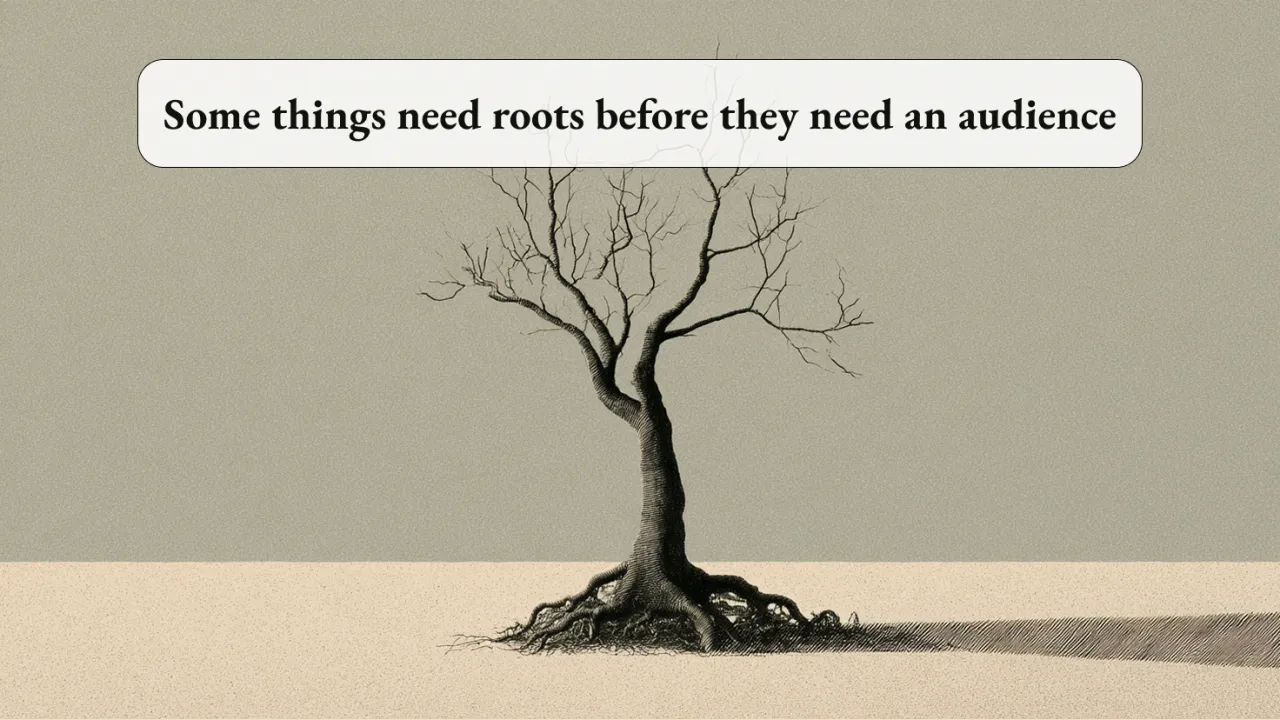
Tai Chi gives me another way to understand this. Root is not the same as refusing to move. It is the quiet organisation that allows movement to carry force without becoming rigid. From the outside, very little may appear to be happening, but the body is learning where weight settles, where tension interrupts connection and what can be released without losing structure.
If I perform the movement before that organisation exists, I can still create an impressive shape. What is missing is the part that makes the shape trustworthy under pressure.
Ideas have a similar period of quiet organisation. They need enough time to discover what they are connected to, what pressure changes them and which parts are decorative rather than structural. Exposure is valuable when it helps that rooting happen. It becomes premature when the appearance of the idea has to be preserved before its structure has been tested.
There is no universal point at which something is ready to be shared. The useful question is not simply, “Should I keep this private or make it public?” It is, “What kind of contact does this need next?”
Sometimes the answer is solitude. Sometimes it is one trusted conversation. Sometimes it is a working prototype placed in front of a real user. Sometimes it is a public article that allows the idea to meet a wider room. The scale of the visibility should match the maturity of the work and the kind of evidence it needs.
This asks for honesty about why we are speaking. Are we sharing because another person can help the work meet reality, or because recognition will temporarily make the work feel real? Are we staying quiet because the idea needs protection, or because reality may give us an answer we do not want?
Some things do need an audience. But first they may need roots, a useful witness and enough silence to become something more substantial than the story we were ready to tell about them.
What are you currently making visible, and what might still need time to take root?
Source text, Han Feizi, “Difficulty of Persuasion”: https://ctext.org/hanfeizi/shuo-nan