· 6 min read
The Darkness Was Not Asking to Be Defeated
James Godwin
Most of us have seen the yin-yang symbol explained as two opposing forces held in balance. Light sits against darkness, good against evil, activity against rest. The wise person, in this version, learns to keep everything in the right proportion and remain somewhere near the middle.
It is a neat explanation, but it has never quite matched life. Day does not negotiate an equal share of the sky with night. Summer does not preserve itself by allowing a measured amount of winter. One condition reaches its fullness, turns, and becomes another.
I was reminded of this by a video from Tom at TangSaying. His interpretation was that yin and yang are better understood as positions within movement than as two fixed substances. He used the image of the sunny and shadowed sides of the same hill. As the sun moves, the sides exchange places. What was in light passes into shadow without becoming evil, broken or less part of the hill.
There are many interpretations of yin and yang, and I do not take one video as the final word on Chinese philosophy. Complementarity, proportion and harmony still matter. What affected me was Tom’s correction to the frozen Western picture of balance, because it gave me a different way to understand an experience I had carried for years.
During my first experience with LSD, I saw myself walking along a line. There was darkness on one side and light on the other. At first, I understood the line as a boundary. I thought I was moving between two territories and that some important part of the experience would be deciding where I belonged.
Then the picture changed. I realised I was not the line between light and darkness. I was not required to choose one side and defend myself against the other. Both were present in me, and neither was the whole of me.
Later, I sat facing a dark forest with a fire burning behind me. The darkness did not feel evil or threatening. I had the sense that a question was coming from where the darkness was, almost as if the darkness itself were asking me, “Why does no one want to sit with me?” I could feel its loneliness, and I felt sad for it.
I am not presenting an LSD experience as proof of what yin and yang truly mean, nor am I recommending psychedelics as a route to insight. It was a personal experience, shaped by the conditions and perceptions of that night. Tom’s explanation helped me see why the memory had remained so powerful.
The darkness had not asked me to become dark. It had not asked to win. It had asked why I treated its presence as a problem that needed to be solved before I could feel whole.
We use darkness as a container for almost everything we would rather not experience. Grief, loneliness, uncertainty, rest, failure and silence are placed there. So are the parts of ourselves that do not fit the identity we prefer to show. We often approach them with the language of defeat, as though a good life is one in which the light finally wins and stays.
That demand appears in work as easily as it does in our inner lives. We expect permanent output, permanent confidence, permanent visibility and permanent growth. A full calendar looks healthy. A quiet period looks suspicious. If our energy drops, a project slows or certainty disappears, we assume something has gone wrong with the system.
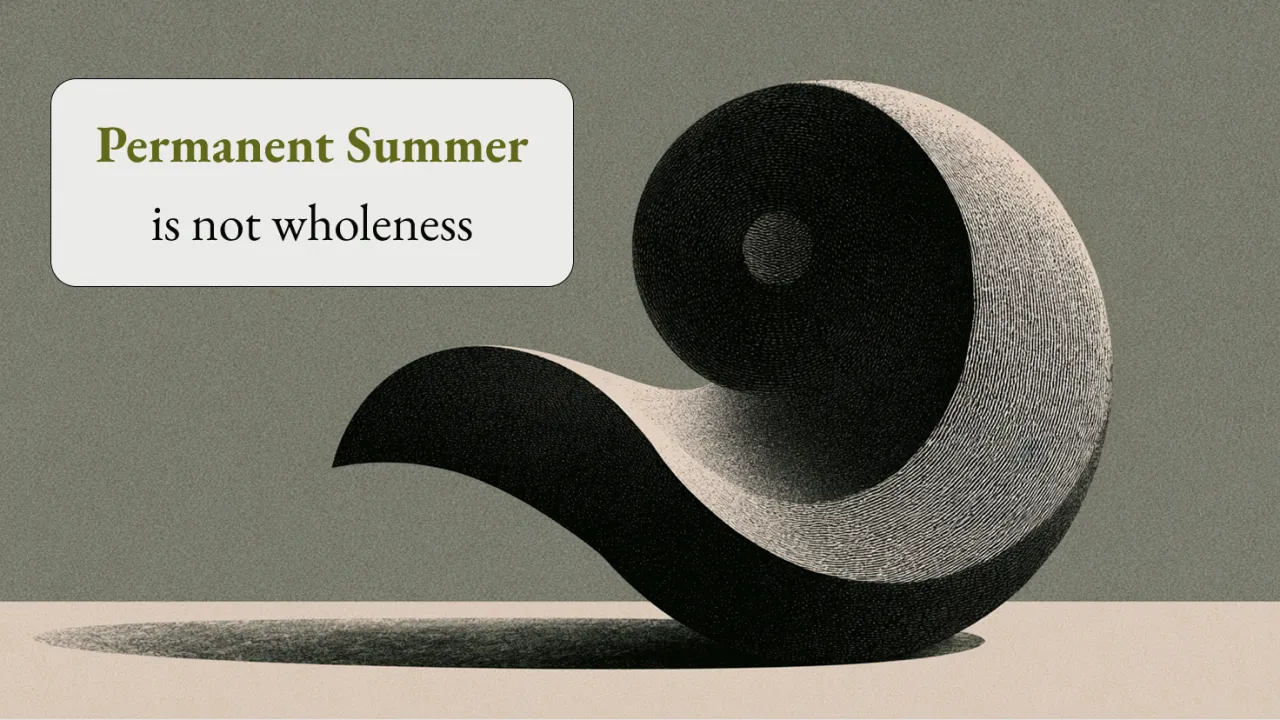
Winter is not a malfunction of summer. A quiet season is not necessarily a broken version of a visible one. Rest is not automatically failure, just as activity is not automatically progress.
This does not mean every difficult season should be romanticised. Darkness is not automatically wiser than light, and pain does not become valuable simply because we endure it. Sometimes a low period is telling us that something needs help, attention or change. Sometimes silence protects fear, and sometimes rest has become withdrawal.
The distinction is not whether a season feels pleasant. It is whether we can meet it honestly without turning it into our permanent identity. A season can be respected without being obeyed forever. We can sit with what is present and still ask what response life requires from us.
The same is true of light. Joy, expression, certainty, connection and growth are not shallow conditions that need to be distrusted. The problem begins when we demand that they remain. Trying to hold life in permanent light creates its own form of fear, because every natural change starts to look like loss.
I have seen this in leadership and product work. A team can become so attached to momentum that nobody is willing to name fatigue, confusion or doubt. A founder can keep increasing visible activity because a quieter period feels like disappearance. A leader can perform certainty long after the situation has become unclear, making it harder for everyone else to say what they can already see.
In each case, the attempt to preserve the bright season blocks useful information. Fatigue may be showing that the pace is unsustainable. Confusion may reveal that ownership is unclear. Doubt may be the first honest response to evidence that no longer supports the plan. Meeting those conditions does not mean surrendering to them. It means allowing them to tell us what the performance of certainty cannot.
This is where the idea of turning feels more useful to me than the idea of perfect balance. Balance can sound like a position I must maintain through constant correction. Turning asks for attention to movement. What is increasing, what is receding, and what has already begun to change?
It also leaves room for timing. Not every condition calls for action at the moment we first notice it. Sometimes recognition is the work that makes a later response possible.
Tai Chi has taught me something similar through the body. If I treat pressure as a fixed enemy, I brace against it and become fixed myself. If I can stay present enough to feel its direction, the pressure contains information about where movement is possible. Yielding is not collapse. It is how I stop fighting an imagined version of the force and begin responding to the one that is actually there.
That does not keep me in a calm middle where nothing difficult happens. It asks me to remain available while conditions change. Sometimes the right response is to advance. Sometimes it is to wait, soften, redirect or let an exhausted pattern finish. The quality I am trying to develop is not control over the season. It is the ability to recognise the season without abandoning myself inside it.
When I think back to the forest, this is what the darkness seemed to be asking. Why does no one want to sit with me? I sensed its loneliness, and I felt sad for it. It seemed to want company, not conquest, and to be experienced without immediately being converted into a lesson, a diagnosis or an enemy.
Wholeness is not choosing darkness over light. It is not staying on a safe line between them, and it is not arranging equal quantities of each. It is knowing that life moves through both and that neither condition has the authority to define the whole of who we are.
We do not become whole by choosing the light. We become whole when we stop abandoning ourselves whenever darkness arrives.
What season of your life are you treating as a failure simply because it does not look like summer?
TangSaying channel: https://www.youtube.com/@TangSaying