· 7 min read
When Your AI Assistant Contains Someone Else's Private Life
James Godwin
It is one thing to put your own private thoughts into an AI tool. It is another thing to paste in someone else’s messages. That line is going to matter more than many people realise, because AI is quickly becoming a place where people process difficult moments that used to stay inside a journal, a private conversation, or the slow work of reflection.
People are already using AI to think through relationships, workplace conflict, family tension, emotional uncertainty, personal decisions, and conversations they do not know how to interpret. In many ways, that is understandable. A good AI assistant can feel patient. It does not interrupt, get tired, rush to defend itself, or lose the thread. It can help someone slow down, organise their thoughts, see patterns, and find words when the situation feels tangled.
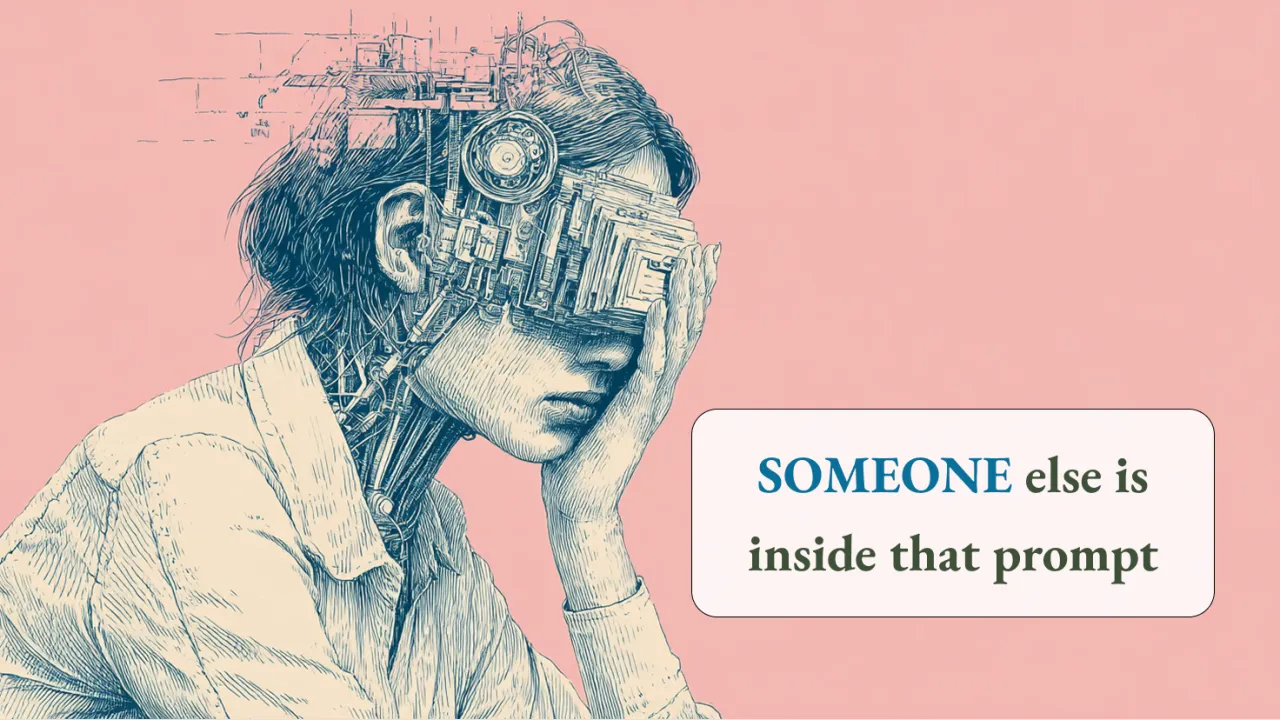
For someone under pressure, that can feel like a private mirror. But it is not only a mirror. When a person copies a long message thread into an AI tool, the data does not only contain their own private life. It often contains another person’s words, fears, confusion, anger, vulnerability, location, work context, family details, health details, financial pressure, or emotional state. The person using the tool may feel that they are seeking help with their own experience, while the other person may have no idea that their private messages have been uploaded into a third-party system.
That is the quiet consent boundary. This is not an argument against using AI for reflection, and it is not a judgement on people who are trying to understand painful situations. Most of this behaviour does not come from malice. It comes from distress, uncertainty, loneliness, speed, and the strange intimacy of a tool that appears to listen without consequence.
The problem is that AI changes the shape of privacy. In a normal journal, someone can write about a difficult conversation. They can describe what was said, how it felt, what confused them, and what they wish they had answered differently. That still contains another person in some way, but the journal remains local to the person writing it. With AI, the boundary is different because the raw material may be handed to a third-party system that can store, process, infer, summarise, and reuse patterns in ways the absent person never agreed to.
The temptation is also different. The tool works better with detail, so the person is encouraged to provide more context. The more context it receives, the more useful it can feel. The assistant can summarise the exchange, interpret emotional tone, infer motives, draft replies, label patterns, suggest next steps, and turn messy human material into something that feels manageable. Usefulness pulls more information into the system, and the more vulnerable the situation, the more tempting it becomes to share the exact words.
Businesses are starting to recognise a version of this problem with client documents. A consultant pastes client notes into a public AI tool. A lawyer asks for help summarising a matter. A therapist drafts from session notes. A financial adviser uses AI to make sense of a client’s circumstances. In each case, the issue is not only whether AI is useful. It is whether the person whose information is inside the prompt gave permission for that use, and whether the workflow has enough boundaries around it.
The personal version is less discussed, but it may become just as common. People will upload message histories from partners, children, parents, friends, colleagues, clients, and staff because they want help understanding what happened. The tool may feel private because the interface is quiet, but the ethical question remains: whose life is inside the prompt?
There are practical ways to handle this more carefully, and the first is to separate reflection from extraction. If you want to understand your own reaction, you may not need to paste the full conversation. You can describe the situation in your own words, remove names, remove identifying details, and leave out anything the other person would reasonably expect to stay between you. You can ask the AI to help you understand your own feelings, options, and communication patterns without feeding it another person’s private text.
That is slower, and it may produce a less precise answer. But sometimes the slower path is the more respectful one. The extra effort creates a pause, and that pause matters because it gives consent, sensitivity, and context a chance to become visible before convenience takes over.
The second thing is to notice when the tool is being asked to judge someone who is not present. AI can make confident-sounding interpretations from incomplete material. It can describe attachment styles, manipulation, avoidance, gaslighting, trauma responses, intent, risk, and character. Some of those interpretations may be useful. Some may be wrong. Some may harden a story before the human relationship has had a chance to breathe.
The person who wrote the original message cannot clarify, object, or add context. That does not mean AI has no place in reflection. It means the user carries more responsibility than the interface makes obvious. A tool that can generate language fluently can also make a partial view feel more complete than it really is.
The third thing is to design safer spaces for sensitive reflection. For some personal use, that may simply mean summarising rather than pasting. For some professional use, it may mean approved tools, clear policies, consent, redaction, data-retention controls, and a review process. For some intimate or highly sensitive work, local or private AI becomes relevant, not because local AI is automatically ethical, and not because cloud AI is always wrong, but because some material deserves a more controlled path than an informal copy-and-paste into whatever assistant happens to be open.
A local AI model running on a machine you control can reduce one part of the exposure. The text may not need to be sent to a public cloud service. The workspace can be bounded. The files can be kept inside a more deliberate environment. That still does not remove the consent question. If the material includes another person’s private words, the question is not only where the AI runs. The question is whether that material should be processed by AI at all, and if so, under what boundaries.
This is where the conversation needs more nuance. Privacy is not only a technical setting. It is a relationship. It is the difference between my information, your information, and our shared context. A message thread between two people is not owned in the same simple way as a private note written by one person alone. It is relational material, and AI makes relational material easy to extract.
That ease can be useful when the work is approved, anonymised, bounded, and reviewed. It can help a business summarise correspondence, find dates, compare documents, or draft clearer updates. It can help a person reflect on a difficult situation with more steadiness. But ease can also make us careless, especially when the interface does not make the ethical boundary visible. It invites more context, rewards detail, responds quickly, and can make the conversation feel private because it is just you and the screen.
Then a third system is holding pieces of someone else’s life. The better question is not only whether AI can help you understand the situation. Often it can. The better question is what you are allowed to bring into the room.
That question applies to businesses, professional firms, teams, families, and private relationships. It applies to client files and WhatsApp threads. It applies to staff records and therapy-like conversations. It applies anywhere AI becomes a quiet place to process material that belongs partly to someone else.
The future of AI privacy will not only be decided by enterprise policies and platform settings. It will also be decided in ordinary moments. Someone is tired. A conversation hurt. A client file is confusing. A deadline is close. The assistant is open. The paste box is waiting. That is where the real boundary lives, not in the abstract debate about AI, but in the half-second before we decide whose private life we are about to upload.